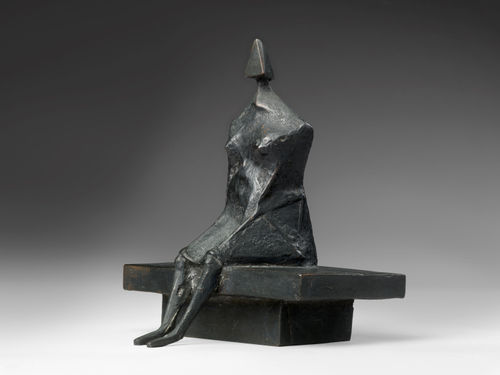
Lynn Chadwick CBE (1914 - 2003) was an English sculptor, known for his semi-abstract bronzes.
Chadwick’s creative career began in architecture, but he pursued a career in sculpture after the Second World War. His early sculptural artworks consisted of delicate hanging mobiles and, after learning to weld in the 50s, larger scale skeletal-like structures created from iron where his sinister spiked forms related the artist to the ‘Geometry of Fear’ group of the 1950s. In 1953, Chadwick began to incorporate stolit (a plaster/iron compound) into his practice, first ‘drawing’ with the metal welded rods then filling in the armatures to make more solid, anthropomorphic forms. These stolit works later formed the working models for his bronze casts of figures and beasts.
In 1956, Chadwick became the youngest recipient of the International Prize for Sculpture at the Venice Biennale over rumoured favourite, Alberto Giacommeti. This granted Chadwick international success and a renowned reputation in 20th century British sculpture alongside Henry Moore.
From the 1970s, Chadwick chose to create works that appeared more human and natural in appearance. These new figures investigated the concept of simply existing within a given space adopting smoother edges and less threatening facades compared to his stern Watcher series of the 1960s. This figurative experimentation continued throughout the remainder of Chadwick’s career, depicting both individual and grouped figures in a variety of poses, including several seated figures. Geometry and balance of form remained a significant aspect of Chadwick’s work, employing a triangle motif to identify his female figures and a square for the male. Towards the end of his career, Chadwick created some works in stainless steel. The material allowed the artist to play with light and space in new ways, once again reimagining his figures and animals as new, futuristic beings.
Chadwick was given the title of Commander of the Order of the British Empire in 1964 and a Commandeur des Arts et des Lettres in 1993. Today, his work is part of esteemed collections worldwide, including Museum of Modern Art (MoMA), New York, Centre Georges Pompidou, Paris and Tate Gallery, London.